

Blue Chihuahua Dogs
There is much speculation about this particular coloring for this breed and may wonder what a blue Chihuahua is. Does it exist? If so, how does it come to be? What exactly is the definition?
There is much speculation about this particular coloring for this breed and may wonder what a blue Chihuahua is. Does it exist? If so, how does it come to be? What exactly is the definition? In this section, we will answer all of your questions regarding this. And it is such an interesting topic!
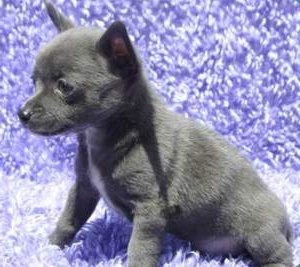
A photo of a very rare solid blue Chihuahua puppy. Most blues will be parti-colored (a two color combination) with the most common combination being tan and blue. With some blues, the coat will appear black and it is only by the dark blue tint of the nose that one can distinguish the official coloring. However, this Chihuahua is a beautiful and shiny slate grey, which only serves to enhance the blue pigmentation of the skin.
A blue Chihuahua, as you may have guessed, not actually a blue color. A true blue is a diluted black. This means that the hue will be a grey or black that, when out in the sunshine, will have a slight bluish tint to the fur.
Out of the 10 different colors that are possible on the coat of the Chihuahua,(not to mention the 20 parti and countless tri-color combinations) this is one of the rarest...and it is truly quite beautiful.
Most commonly, you will see a blue with other colors, such as a blue with white markings, with tan, etc. Therefore, a solid blue is even much more rare than one with parti markings (2 or more colors on the coat) or a tri coat (3 color combination).
This color can be found on both varieties of the Chi…. The short coat (also known as a smooth coat) and the long coat. The possibility of the gene being present for this amazing coat color is not more common in either variety Chi.
Unfortunately, since this is a unique hue, some breeders will try to pass off a gray or silver as a blue. The AKC (and other dog registries) allows for a breeder to check of the color of the puppy on the papers… therefore papers that show a blue Chihuahua are not proof that the dog is actually that color….And this sadly leads to potential owners willing to pay much more money for a uniquely colored dog that may simply be a gray or silver.
If you are looking for a Chihuahua that holds this rare color, one way to have more assurance that you are getting what you pay for is to physically look at pup in person. This should be done outside. In bright sunlight, you should be able to see a blue tint the paw pads, eye rims and most noticeably, the nose.
It does not always help to look at the parents. This is because a blue can be produced from a tan and a black; however both dam AND sire must have the recessive blue gene that is carried down to the puppy.
It should be noted that even if one unethically breeds two blues together, the resulting litter may have only tans, browns and fawns. There is no guarantee on the color of the litter. Since this is a recessive gene, it can be in the bloodline, but skip 1, 2 or 3 generations.
Most reputable breeders will not pair two blues together and there is a very good reason why. Studies have shown that this can cause health issues
in the litter including issues with the substance of and health of the coat.
This is because it is a diluted color and carries hidden defects… when two are bred together this can result in a litter with a variety of health problems, the most common being issues being impeded growth of the coat and alopecia skin problems.

Names for Blue Chihuahuas
Aqua, Ash, Azure, Azul (blue in Spanish), Baby Blue, Blue Boy, Blue Girl, Bluebelle, Blueberry, Celeste, Cobalt, Cornflower, Cyaneous, Denim, Hue, Icy, Indigo, Iona, Lake, Lucia (Italian for 'ocean blue') Marble, Marine, Misty, Navy, Periwinkle, Polu (blue in Hawaiian) Royal, Sapphire, Seal, Sky, Slate, Sledge, Spectre, Steel, Smokey, Wolf